
The future of local government is already here: Key insights from the West Midlands public sector AI Festival
With councils facing rising demand, financial constraint and ongoing workforce pressures, the question of how work gets done is under increasing scrutiny. At the same time, generative AI is already beginning to shape how staff and citizens interact with services.
In January 2026, West Midlands Employers brought together councils from across the region for the first Public Sector AI Festival, creating a shared space to explore what generative AI means for the future of work and public services. Supported through the Workforce Priority Fund, the festival was designed to move the conversation beyond technology alone. The focus was on how councils can adopt AI responsibly, build workforce confidence and ensure emerging tools deliver meaningful impact for both staff and citizens.
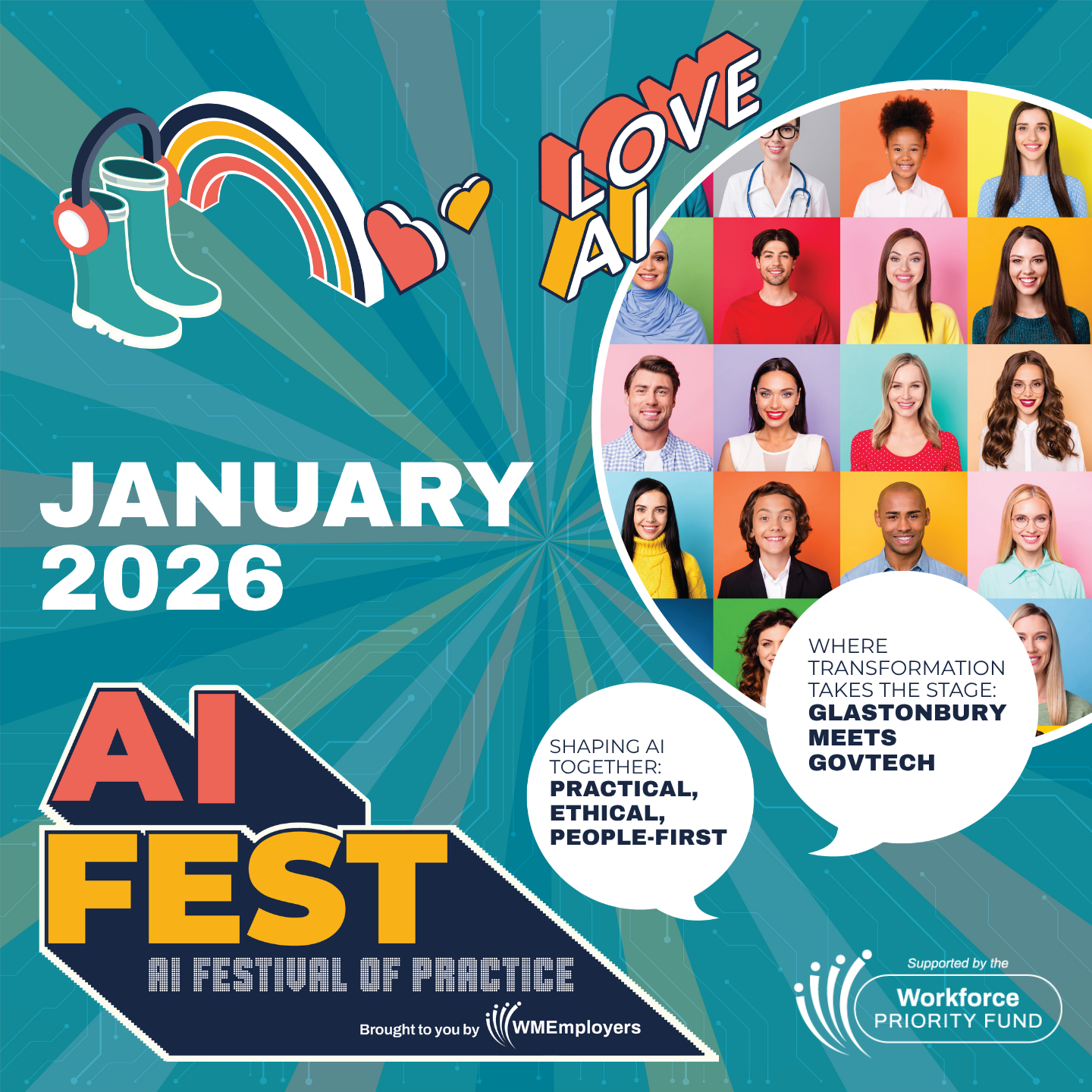
Over five days the festival hosted:
- 12 live sessions
- 1,115 registrations of interest
- 617 unique participants
- 1,607 dial-ins across the week
Participants joined from across the region’s councils and wider public sector, representing a broad range of roles and services including HR, digital, social care, customer services, policy, communications and operational teams.
A key strength of the festival was the willingness of councils themselves to share their learning openly.
Case studies from across the region provided practical insight into how organisations are beginning to explore AI in real operational contexts.
Sessions covered themes including improving productivity and accessibility for staff, building confidence in tools such as Microsoft Copilot, establishing appropriate governance and ethics, and maintaining a clear human-in-the-loop approach as technology evolves.
The week also featured contributions from leading international voices including Heather Murray (AI for Non-Techies), Christine Armstrong (future of work expert) and Jazz Rasool (AI ethics and governance specialist).
Their insights helped connect global trends and emerging risks with the day-to-day realities of local government, reinforcing the value of collaboration and peer learning across the region.
Absolutely brilliant! Thank you. Incredibly thought provoking!!
AIFest Attendee
I'm still mind blown from this mornings thought provoking session Great Festival.
AIFest Attendee
Practical lessons for councils on the AI journey
A number of consistent themes and phrases emerged that provide a practical guide for councils at any stage of their AI journey:
- Return on intention: Success is not just about efficiency.The biggest gains often come from improved experience, engagement and reduced frustration — but only if there is clarity about what you are trying to change.
- Adopt ? Sustain ? Optimise: Moving from pilot to impact requires deliberate effort. Without a focus on sustaining new ways of working, early momentum can quickly be lost.
- AI Amnesty: People are already using AI tools, whether formally supported or not. Creating safe spaces to share what’s working helps organisations understand real use and build the right guardrails, rather than operating in the dark.
- You can’t outsource curiosity: AI adoption cannot sit with IT or external partners alone. It requires active engagement from leaders and teams across the organisation.
- It’s only a first draft: AI can accelerate work, but it does not replace judgement. Human oversight remains essential to ensure quality, accuracy and accountability.
- AI gives you information. People bring the wisdom: Technology can support decision-making, but it is human experience, context and values that turn insight into meaningful action.
These insights reflect a shared understanding across councils that successful adoption is not just about introducing new tools, but about shaping behaviours, expectations and ways of working.
One of the highlights of the festival was the launch of the WM ADASS AI Playbook, which uses lived experiences from citizens to explore how AI could help transform support and services in the future. This grounded the wider conversation firmly in the purpose of local government: improving outcomes for communities and left councils with takeaway resources.
Across the week, it was clear that this is no longer a future conversation. Colleagues and citizens are already using AI in their day-to-day lives, and councils are beginning to respond. We saw practical examples of teams using AI to reduce administrative burden, improve accessibility and create more time to focus on people.
For many organisations, the festival marked a shift from awareness to early action with leaders and teams starting to explore how tools such as Microsoft Copilot can be used safely and meaningfully in their own context. Alongside these practical examples, the festival reinforced that AI is not something councils can afford to observe from the sidelines.
The question is no longer whether to engage, but how to do so with clarity and intent. Without that, there is a risk that AI becomes another tool deployed in the name of efficiency alone, rather than something that genuinely improves experience, builds capacity and supports better decision-making. For leaders, this is not a digital issue to delegate, it is a workforce and service issue that requires active ownership.
A special thank you goes to colleagues from Birmingham City Council, City of Wolverhampton Council, Walsall Council, Telford & Wrekin Council and Coventry City Council, who generously stepped forward to share their experiences with peers across the region.
Their openness, honesty and willingness to discuss what is working and what they are still learning created some of the most valuable moments of the week.
By sharing practical examples and real organisational insight, they helped move the conversation from theory to practice and demonstrated the strength of councils learning together across the West Midlands.
The response from participants was overwhelmingly positive, with feedback showing 100% of respondents would like the festival to run again.
For many councils, the festival provided a valuable opportunity to hear directly from peers, understand how others are approaching AI, and begin shaping their own response.
More broadly, the festival demonstrated the power of regional collaboration with West Midlands Employers providing a platform for councils to learn together, share emerging practice and navigate one of the most significant workforce and service transformations of the coming decade. And if the week proved anything else, it’s that council staff clearly have excellent taste in music.
From the 80s through to the 00s, the pre-session playlists became an unexpected talking point - a reminder that even in a week focused on technology, what really brings people together is still human.
Thank you for such a diverse range of webinars across the AI festival this week. I feel that I have a better understanding of AI and feel more confident to embrace AI tools in the workplace and in life more generally.
AIFest Attendee
We’re here to help
From leadership development to culture change, see how we can unlock your team’s full potential.
Michelle O'Neill
Principal Consultant
Leadership & Organisational Development