
A live talent pool model for the future of council leadership
Like many councils, City of Wolverhampton Council was thinking hard about the future of leadership, succession and internal talent. This was not simply about running another leadership programme or offering people a few development days away from the day job.
The ambition was bigger than that. The council wanted to create a more meaningful way of identifying and growing future leaders from within, while also testing what modern succession planning could look like in practice. That meant thinking about talent management, leadership development and succession planning not as separate conversations, but as part of one joined-up workforce challenge.
From the outset, there was a clear appetite to do something bold: create a live talent pool model where participants would not just learn about leadership, but actively experience it in real work, with real expectations, support and visibility. The original design placed the programme within the council’s People Development and Experience service, with a commitment to backfilling roles so talented people could genuinely step into the opportunity rather than squeeze it around an already full job.
That foundation mattered. It signalled that this was not talent theatre. It was a real investment in growing the council’s future leadership bench.
From concept to implementation: building momentum for future leadership
WME’s role combined strategic design, challenge, delivery support and wider leadership development insight. In practice, this support has been both strategic and hands-on. Alongside co-design, WME has contributed to the live delivery of the programme through individual and team coaching support, targeted mini labs focused on live leadership challenges, and the Shift Series.
We are still at the early stages of their 12-month journey. It has taken four months of design, challenge and careful setup to reach this point. The most important headline is that the programme has moved from concept to implementation, with the team of five now in place, early support provided, and strong momentum building, with the groundwork now in place for them to helicopter into their first service-based transformation projects.
Why this matters to the wider sector
For councils thinking about succession planning, this work offers an important provocation. If we are serious about growing our own, we need to move beyond occasional development activity and design clearer, more practical pathways for future leaders to emerge and be tested.
Our Future Leaders shows what can happen when talent management, leadership development and succession planning are brought together into one live, practical model. It demonstrates that councils do not need to choose between operational reality and workforce ambition but they do need to design carefully enough to make both possible.
In many ways, this is less about getting everything right from the start and more about being willing to learn, adapt and build something better together as it unfolds.
Turning leadership potential into a real organisational pipeline
- How do you define potential in a way that is fair, modern and meaningful?
- How do you test it in practice, rather than relying only on interviews or written applications?
- How do you create a psychologically safe environment where people can learn, stretch and occasionally wobble without that becoming career-limiting?
- How do you ensure participants are not just learning, but contributing, delivering against live council priorities and being accountable for outcomes?
- And, crucially, what happens after the programme if individuals are not yet stepping immediately into their next substantive role?
Too often, organisations identify talent but do not create enough structured opportunity for it to grow. Or they run a strong programme, only for the energy to fade at the end because there is no clear approach to readiness, visibility, alumni support or onward progression.
Designing a future-ready leadership model built around real experience
WME was approached to work in partnership, help strengthen, shape and co-deliver the model.
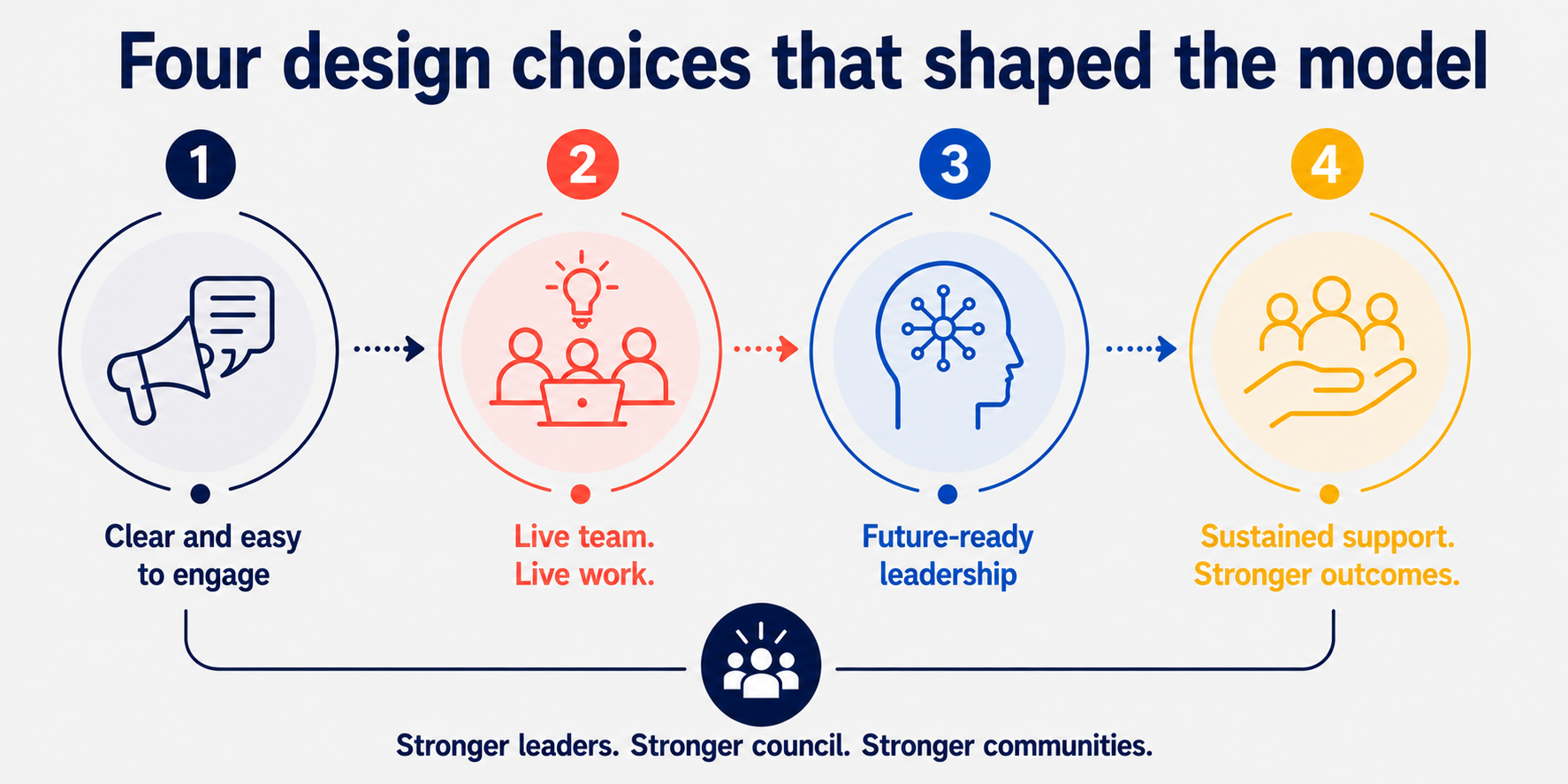
Thanks to Workforce Priority Funding, WME invested a small amount of time to work alongside the council in shaping the pilot model and bring it to life with regional visibility. This included external challenge, supporting early design and capturing learning that could be shared more widely across the sector. In parallel, the council made an investment in WME to support delivery of key elements of the programme. Together, the work focused on several important design choices.
First, we helped sharpen the overall proposition so it was easier to communicate and easier to engage with. If people do not understand what they are applying for, what will be expected of them, and what the organisation is committing to in return, even the best ideas can become blurry. Simplicity mattered.
Second, we worked with the council to protect the thing that made this model distinctive: it would be a live team, doing live work not a classroom simulation. This was not just about learning, it was about doing, with participants working on cross-council challenges while actively testing new ways of leading.
Third, we brought a future-ready leadership lens. Rather than preparing people only for the roles councils have always had, the programme was shaped around the reality that leadership is changing. GenAI, systems thinking, complexity, influence, non-linear careers and changing workforce expectations all needed to be part of the conversation not bolted on as an optional extra.
Fourth, we helped hold attention on the bit many organisations overlook: the “after.” Early on, we identified the need for a post-programme phase that would keep people warm, visible, supported and ready for the next step, rather than allowing newly developed talent to drift, become frustrated or leave.
What made the model different
A number of features made this approach stand out in practice.
- Real work, not simulation: Participants learn through doing, contributing to cross-council priorities and testing their leadership in real time.
- Backfill as essential infrastructure: In local government, one of the biggest barriers to developing talent is operational reality. By committing to backfill, the council addressed that barrier head on and made participation genuinely possible
- A broader definition of potential: Potential was not defined by confidence or prior senior experience alone, but by curiosity, adaptability, influence, systems thinking and the ability to grow into complexity.
- A different entry point: The recruitment process moved beyond traditional applications, giving people opportunities to demonstrate how they think, collaborate and respond to challenge, not just how they present themselves on paper.
- Support for all applicants: Through a regional coaching cohort, all applicants - not just those selected - were offered coaching support, reinforcing that potential is something to be nurtured widely and extending the reach of the programme beyond the core cohort.
- Executive leadership in practice: The Chief Executive and senior leadership team have been actively involved throughout, going beyond approval or sponsorship. They have participated in recruitment simulations, mentored individuals, shaped programme priorities and reviewed progress against live service delivery. This has provided participants with direct exposure to senior leadership thinking, while giving the executive team greater visibility of emerging talent and the strength of the future leadership pipeline.
Alongside these core features, a number of deliberate design choices helped bring the model to life and strengthen its impact. The programme has been intentionally designed to build a wider talent ecosystem, connecting the core cohort with others at similar stages of growth, including AI change agents and senior managers preparing for their next step.
This recognises that leadership pipelines are not linear, and that creating visibility and connection across the system is as important as developing individuals in isolation. There has also been a strong emphasis on leadership identity, not just capability. Participants are supported to think about how they show up, how they influence beyond their role, and how they build credibility across services reflecting the increasing importance of voice, presence and relational leadership.
A further deliberate choice has been to inject future-focused thinking, rather than reinforcing traditional models of leadership. Through the Shift Series, participants are encouraged to explore themes such as complexity, systems thinking, GenAI, non-linear careers and influence helping them make sense of the environments they are already operating within.
Core Shift Series themes have included, for example:
• Anticipating the Future of Work: The Changing Role of Leadership
• Harnessing AI in Local Government
• Systems Thinking for Everyday Leaders
• Decision-Making in Complexity: Leading Through Uncertainty
• Future Power: Rethinking Authority and Voice
• Leading Out Loud: Voice, Story and Influence
• From Ladder to Squiggle: Leading Non-Linear Careers
• Emotional Intelligence in a Complex World
• The Resilient Leader: Avoiding Burnout in High-Stakes Leadership
• Embedding Organisational Creativity and Innovation
• Ethical Leadership in a Transparent World
• From Peer to Leader
• From Operational to Strategic Leadership
• Political & System Influence
Together, these elements reinforce a core principle of the programme: leadership in local government is evolving, and those stepping into it need to be equipped not just with capability, but with perspective.
Defining potential and thinking beyond the programme
A key part of the work has been developing a more practical and shared understanding of what “potential” really means in a local government context. Rather than relying on traditional indicators such as confidence, visibility or prior senior experience, the programme has taken a broader view. Potential has been considered in terms of how individuals:
- learn and adapt in new or ambiguous situations
- work across boundaries and build relationships
- influence without formal authority
- make sense of complexity and competing priorities
- show curiosity, judgement and a willingness to grow
- understand people, demonstrating ability to respond to different needs and perspectives
- recognise and unlock the uniqueness in others, creating environments where others are at their best
Importantly, this has not been treated as a fixed definition, but as something to be tested and refined through real experience, observing how individuals contribute, respond to challenge and develop over time.
Alongside this, early thinking is already underway about what comes next. If organisations are serious about building internal pipelines, development cannot stop at the end of a programme.
The focus is beginning to shift towards how individuals are supported to stay “warm”, remaining visible, connected and ready for future opportunities. This includes considering:
- how readiness for progression is defined and evidenced
- how individuals continue to access stretch, exposure and support
- how a connected talent community can be sustained
- how learning from the programme informs wider workforce and succession planning
These are not fully solved questions and nor should they be at this stage.
The next phase of the programme will provide a valuable opportunity to test, learn and refine what might work. What is clear is that sustaining momentum matters. If organisations are serious about growing their own, attention needs to extend beyond identification and initial development towards how talent is nurtured, supported and retained over time.
 Our Future Leaders programme represents exactly the kind of bold, values led approach we need if local government is to thrive in a fast changing world.
It is more than a leadership programme, it is a clear statement of intent about who we are as an organisation and how seriously we take our responsibility to grow our own future leaders and leaders who are able to fully understand how the council operates and with strong transferable skills.
Working in partnership with West Midlands Employers has been central to shaping this model.
Their challenge, insight and practical support have helped us move beyond traditional development approaches and create something that genuinely tests leadership potential through real work, real accountability and real contribution to council priorities. What I am most proud of is that this programme is not talent theatre.
By investing properly, we have shown that developing our future leaders is core to how we run the council, not an optional extra. Participants are learning by leading, delivering meaningful outcomes for the city while building the confidence, perspective and capability needed for the future of local government.
A really good practical example of this is how our current cohort of future leaders have worked on the council election, supporting our core election team, rapidly bringing themselves up to speed and relieving the pressure on the election team whilst at the same time getting valuable experience of a key council function.
This work gives me real confidence in the strength of our internal leadership pipeline. It reflects our ambition for Wolverhampton to be an organisation where potential is recognised, nurtured and stretched fairly, and where people can build long term careers while making a real difference.
Our Future Leaders demonstrates what is possible when we commit to growing our own and are brave enough to do things differently.
Tim Johnson
Chief Executive, City of Wolverhampton Council
We’re here to help
From leadership development to culture change, see how we can unlock your team’s full potential.
Michelle O'Neill
Principal Consultant
Leadership & Organisational Development