From Faithless to Fearless: Reflections from the Festival of AI in Practice
Posted on: 12/02/2026
Thought Leadership
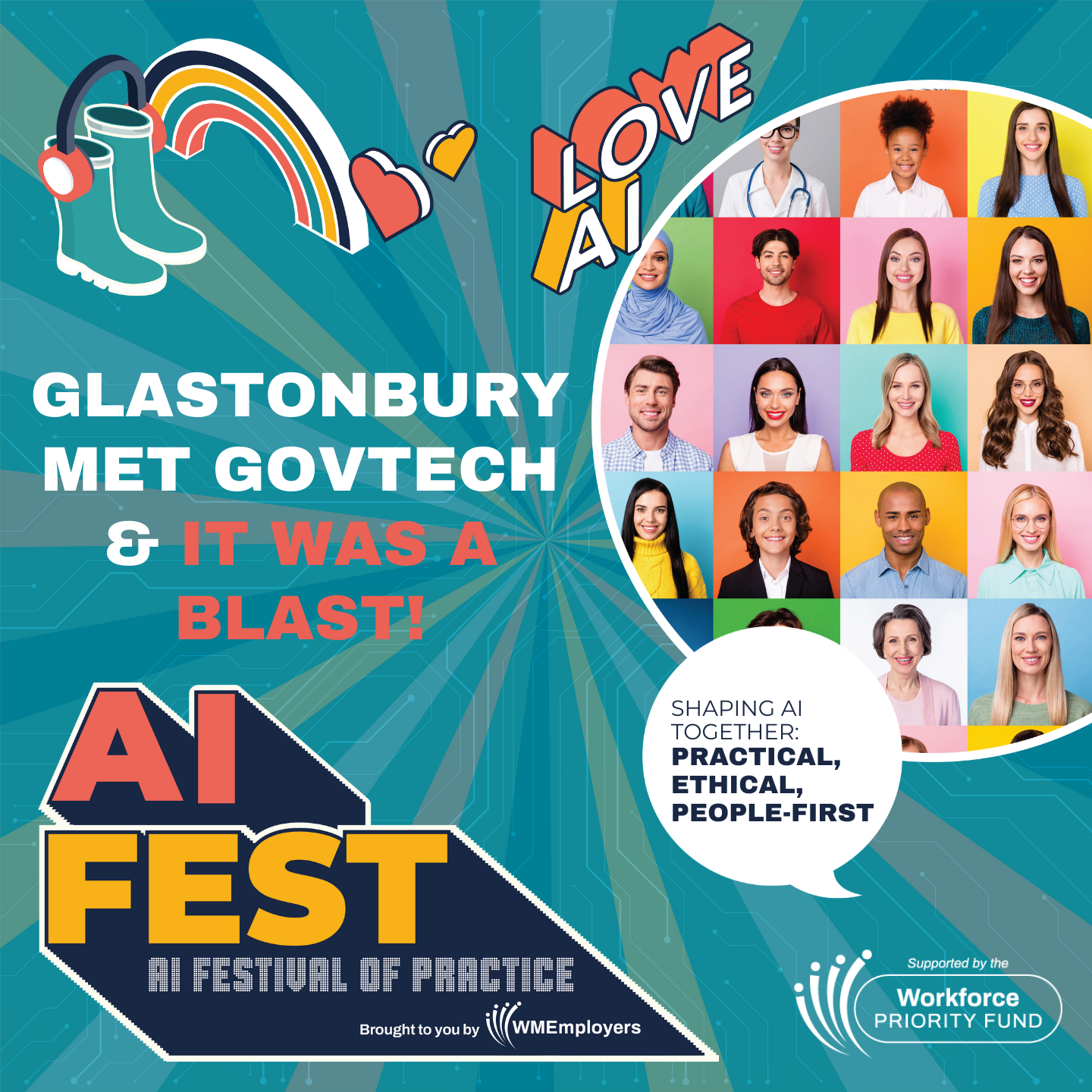
Michelle O’Neill reflects on the Festival of AI in Practice and what it revealed about AI in local government. Across five days and 1,600+ participants, the message was clear: AI is a people and leadership issue, not just a digital one. The article explores readiness over speed, the importance of purpose and “return on intention”, and the need for honest conversations about adoption, equity and governance. From Copilot rollouts to AI amnesty and behaviour change, Michelle argues that intentional, human-centred leadership is what turns AI from hype into meaningful transformation.
 From Faithless to Fearless: Reflections from the Festival of AI in Practice
By Michelle O'Neill, Principal Consultant OD, Leadership and Learning at West Midlands Employers
If you’d told me a year ago I’d be curating a festival about Artificial Intelligence for local government complete with keynote speakers, pre-session bangers (yes, Insomnia was our most-requested track), and a silent disco full of recorded sessions, I’d have probably raised a slightly sceptical eyebrow.
But I’ve also never been more sure that this is exactly where we need to be.
Over five days, 12 sessions, and 1,600+ dial-ins, we saw councils show up with honesty, curiosity, and ambition. The cross-cutting theme was loud and clear: this is about people.
And while we called it a Festival of AI, what we really hosted was a festival of intentional transformation wrapped in music, humanity and future-focused optimism.
Let’s get something out of the way: silence is not golden. But neither is rushing headlong into rollout without reflection. You don’t win this race by being the hare, you win it by being ready.
Every speaker, every case study - from Copilot to Magic Notes to AI Playbooks - showed us that readiness isn’t about being perfect. It’s about being honest. It’s about getting clear on the problem you’re trying to solve and the difference you want to make.
So let’s stop talking about intent like it’s some airy, unmeasurable thing.
Start by asking:
- What exactly do we want to feel different?
- For whom?
- By when?
- And how will we know if we’ve made progress?
Your KPIs don’t all need to be numbers. Sometimes the best measures are stories, confidence, capacity unlocked, conversations that start happening again. Return on intention is real, if you’re clear enough to track it.
This AI stuff isn’t a future skills issue. It’s a now skills issue. This isn't just a job for your ICT leads or innovation teams. If we want councils that are ready for the future, everyone - yes, everyone - needs to understand how these tools are changing the shape of work.
And that Includes you, as leaders
If you’re reading this thinking “AI isn’t really my thing it sits with digital”… you’re not alone. But you’re also not helping. AI isn’t something to quietly bury in an efficiency plan or delegate to a team with a dashboard. This will touch, for better or worse, every colleague and every citizen your council serves.
When budgets are tight and expectations high, anything that creates space, clarity, or capacity isn’t a nice-to-have, it’s business critical, surely?
But alongside that opportunity is a responsibility: to resist the temptation to automate away the nuance. To prioritise human skill, not outsource thinking. To ensure tech complements the workforce, not quietly replaces what makes them brilliant. Leadership in this space doesn’t mean you have all the answers. It means you’re willing to ask better questions.
A few phrases became festival favourites, for me:
Return on Intention – If you don't know what you're trying to change, how will you ever measure if it’s working? Not everything is about ROI in pounds and minutes. Some of it is about trust, clarity, headspace.
AI Amnesty – Chances are your staff are already using tools you haven’t authorised. You can try and shut it down (probably impossible), or you can open the conversation. Ask what they’re using, what for, and what they wish they had. Turn shadow AI into shared insight.
The Crater of Disappointment – Too many Copilot rollouts die quietly in week three according to Microsoft. That post-launch slump is real. So what’s your sustain plan? Who’s checking in? Who’s celebrating wins? Who’s reminding people what good looks like?
Activity Burst – One council moved some of their Copilot licences around the organisation based on need, not hierarchy. Someone writing a report? Give them Copilot for the week. Finished? Hand it on. Not everyone needs a full licence all the time. Smart, agile, cost-conscious.
Prioritising Need – Let’s talk equity. Copilot is game-changing for colleagues with dyslexia, neurodiversity, or communication challenges. Shouldn’t that be part of how we allocate licences?
f you’re leading transformation, these are the kinds of conversations you should be having in your senior team, your project boards, your performance reviews.
Copilot was loud and proud across the week and rightly so. It’s the thing everyone’s asking about. But what was powerful was hearing how different councils are using it. Some are experimenting. Some are embedding. Some are trying to keep up with staff who’ve already made it part of their day.
If your rollout strategy ends at “let’s turn it on and offer a few tutorials,” let me gently suggest that’s not going to cut it.
This is as much OD as it is ICT. If you don’t have someone thinking about behaviour change, adoption, confidence, support, it’s time to build that in.
AI will give you access to more knowledge than you’ve ever had before. But it’s your people who’ll turn that into wisdom. Into action. Into services that make sense for the people you serve.
As we close the (virtual) gates on our festival, let’s not forget that the most important conversation we had all week wasn’t about data, devices or dashboards. It was about decision-making. About power. About what happens when no one is watching. Governance isn’t a bolt-on, it’s the anchor. Ethics can’t sit quietly on the sidelines, or appear once in a policy doc no one reads. It needs to be felt in the design, the deployment, and the day-to-day use of every tool we adopt.
So here’s what I’d suggest:
- Start with purpose - If you're not clear what your AI use is trying to solve and for whom, stop. Go back. Get focused. AI will amplify what you already have: clarity, confusion, or inequality.
- Bring diverse voices in early – Don’t wait until post-launch feedback to realise the solution doesn't work for everyone. If they can’t see themselves in the process, they probably won’t trust the outcome.
- Transparency builds trust – Say what the AI can and can’t do. Say how decisions are made. If AI is involved in assessments, communications, triage, be open. No one wants to feel tricked.
- Governance isn’t bureaucracy it’s liberation – Done well, it gives teams clarity, not constraint. It’s the thing that lets you move fast and stay safe.
PS: If Copilot is your hot topic...Our Ultimate Copilot programme starts 3 March and 8 Septembner. You’ll learn, build, and connect with peers across the region.
PPS: If your teams are grappling with where AI fits in, or if leaders are struggling to step into the space with confidence, coaching can be the catalyst.
View Copilot Ultimate Programme